

The Listening Moon
The moon comes up differently here.

February 11, 2026
It doesn’t climb. It settles. I didn’t notice it at first. Standing there, watching the last color drain out of the hills, and somewhere between the sound of the river turning over on itself and the cedar branches brushing together, the light changes. The world softens. Edges blur. What was sharp a minute ago feels almost forgiven.
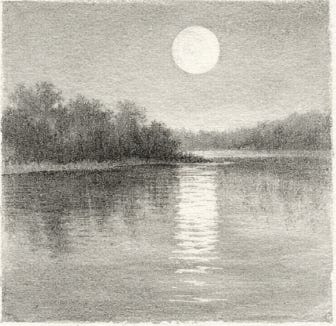
There’s a bend in the river where the current slows just enough to catch the sky. On certain nights, the moon lies itself down there like something set gently on a wooden table, no splash, no announcement—just a quiet presence. If I didn’t know better, I’d think the river was holding it.
I’ve come to think of that light as a kind of listening moon. Not because it says anything, it doesn’t. Just gravel roads, old sycamores, and cabins tucked back into the trees. But there’s something about these evenings that feels gathered as if the night itself has pulled up a chair. As if the hills lean in, not to speak, but to listen.
Steam rises from the cup in my hands and disappears before it reaches my face. It does that every time, lifts, swirls, vanishes. I’ve watched it enough to know it isn’t lost. It’s just the way warm things meet cool air. Things move at their time. The river doesn’t hurry. The moon doesn’t strain. And for a little while, neither do I. Most evenings, that feels like enough.
There used to be a little store up the road from here. I wouldn’t have found it on purpose unless someone told me where to turn. Just a low-slung building with a faded Coke sign, a gravel pull-off, and a bell over the door that announced whether you wanted to be announced or not. The coffee was always stronger than it needed to be, and the floor had that soft sag in the middle where years of customers had decided to stand in the same place.
The store is gone now, and not torn down in any dramatic way, and just closed. Windows boarded once, then weathered, then forgotten. The sign fell last spring in a wind that didn’t even make the evening news. By summer, the grass had pushed up through the gravel lot like it had been waiting its turn. Places don’t always disappear loudly. Sometimes they fade like the steam off a cup.
In the silence of the evening, I can still hear the scrape of chairs on linoleum and the low murmur of men comparing river levels like they were reading scripture. Nobody there claimed to understand much about the world beyond Baxter County, but they knew when the river would rise and when it would settle. They knew which stretch held browns deep in the cut bank and which bend was better left alone after a rain. No one went to solve anything, to sit.
On a cold Ozark winter morning, you could step inside and feel the air change, not warmer exactly, just closer. Someone would nod. Someone would slide the sugar jar down the counter without being asked, cup with coffee waiting. Conversation moved as the river does here at dusk - steady, patient, never in a rush to arrive anywhere.
Now, when I drive past that spot, there’s nothing to slow down for. No bell. No burnt coffee. Just a structure where something once gathered people without trying too hard. The moon still shines over that gravel lot. And on nights like this, with the river holding its quiet reflection, I wonder if places ever really leave, or if they move into memory and wait there, lit softly, like a lamp set in the window of a house that no longer stands.
The river has always been the better listener. You can tell by the way it carries things without complaint, leaves, light, and the occasional broken branch. It doesn’t argue with what falls into it. It receives. It shifts around the weight and keeps moving. On certain mornings, before the fog burns off, the White looks less like water and more like breath. Slow exhale drifting just above the surface. You’ll see a figure standing waist-deep near the far bank, line arcing soft through the air, and from a distance they seem less like a fisherman and more like someone measuring silence.
Nobody talks much out there. Not because there’s nothing to say, but because the river doesn’t require it. Words feel oversized against that steady current. So, we keep them small. A nod. A lifted chin. Maybe a half-smile when someone lands a brown that pulls harder than expected. It’s not a gathering like the old store used to be. No counter. No chairs. No bell on the door.
If you stand still enough, you can feel it, that sense that the world is gathered without noise, that whatever once sat at a wooden counter up the road has shifted downstream, waiting here instead. Nobody announces it. But the river remembers.
There was a neighbor who used to stand at that bend most evenings. Not every day. Just often enough that you expect him there. Lean frame. Old canvas hat pulled low. The kind of man who didn’t waste words, not because he was unfriendly, but because he didn’t believe in crowding a moment.
We never talked about much—the river level. Weather coming in from the west. Once, about a dog that had gone missing for three days and came back thin but proud of wherever it had been. The sort of conversations that don’t feel important at the time. Just filler between casts.
Then one week, he wasn’t there. Someone at the Dollar General said he’d moved closer to his daughter up near Kansas City. Someone else thought it might’ve been something altogether different - said with that air of ominous certainty that comes as we get older. Nobody seemed certain. Here, news travels slowly and settles even more slowly. It doesn’t chase you down. It arrives one morning like frost, expecting to be noticed. The last thing he said to me was something about the way the browns were holding deeper than usual. I nodded. We both looked at the water instead of each other. That was it.
In this life, we never know which goodbye is the real one. It isn’t always the hospital room or the handshake at a moving truck. Sometimes it’s a sentence about fish, weather, or a covey on the walk down from the pickup. Sometimes it’s a simple nod, a shared silence, we assume will happen again.
Standing here now, under this same steady moon, I can almost place him where he used to be — boots anchored in gravel, line cutting a soft arc against the sky. The river doesn’t seem bothered by his absence. It keeps its rhythm. But I feel the shape of where he stood, like a chair pulled back from a table that hasn’t yet been pushed in.
The moon doesn’t explain things. It just lights what remains. And on nights like this, that feels close enough to understanding.
My thermos is lighter now. I didn’t notice when it happened. One minute, the cup is warm in my hands; the next, it’s just comfortable. The kind of warmth that lingers without insisting on itself. The boys have given up pretending they’re alert. One of them is stretched long across the boards, chin on paws, watching the tree line as if he expects something to step out of it. The other two are curled tight, breathing slow, rising and falling like small tides against the porch.
The hills are darker now. The river is almost invisible except for that thin ribbon of silver where the moon insists on being seen. There’s a moment each night when everything seems to agree—the current quiets. The breeze pauses. Even the cabins tucked back into the trees seem to settle.
A moment such as this cannot be forced. If you try, it will slip from our grasp. But if we sit long enough, it arrives on its own. I used to think gathering was about people, about conversation, about shared tables and leaning shoulders. But maybe it’s simpler than that. Maybe it’s the pause. Maybe it’s this right here — boots resting, river moving without hurry, the moon laying its light down on whatever remains without asking what changed or who left or what used to stand where grass now grows.
The old store is gone. The neighbor moved on. Seasons turned like they always do. And yet this still happens. The moon rises. The river holds it. The night gathers what’s left. For a little while, under a sky that doesn’t argue with anything, the world feels less like something to manage and more like something to sit inside.
I take the last sip. It isn’t hot anymore. But it’s enough.
By the time the thermos is empty, the moon has climbed higher, though it doesn’t feel like it climbed at all. It simply stayed. That’s the part I’m learning. The river will change banks over time. Gravel bars will shift. Stores will close. Neighbors will move closer to their children or farther from the water. Names will fade from mailboxes. Stories will thin out around the edges. But the moon does not rush to explain any of it. It lies across whatever remains.
Tonight, it rests on the bend where we used to stand. On the gravel lot where the bell once rang. On the porch boards beneath my boots. It doesn’t choose between what was and what is. It makes room for both.
The river catches that light and carries it downstream, breaking it into a thousand small tremors that look, from a distance, like something alive and breathing. Maybe that’s all memory ever is — light carried forward, reshaped by motion, but never entirely lost.
The dogs stir. Cooper lifts his head and listens to something I can’t hear. The hills hold their dark outline against the sky. Nothing resolves, and honestly, nothing needs to. Somewhere beyond the trees, an owl calls, the world keeps moving, roads clearing, shelves refilling, people submitting to clocks and obligations. But here, for this small stretch of night, the hills lean close, the river keeps its rhythm, and the moon sets a quiet table no one had to build.
I sit quietly. And the listening moon, steady and unhurried, stays long enough for me to notice.